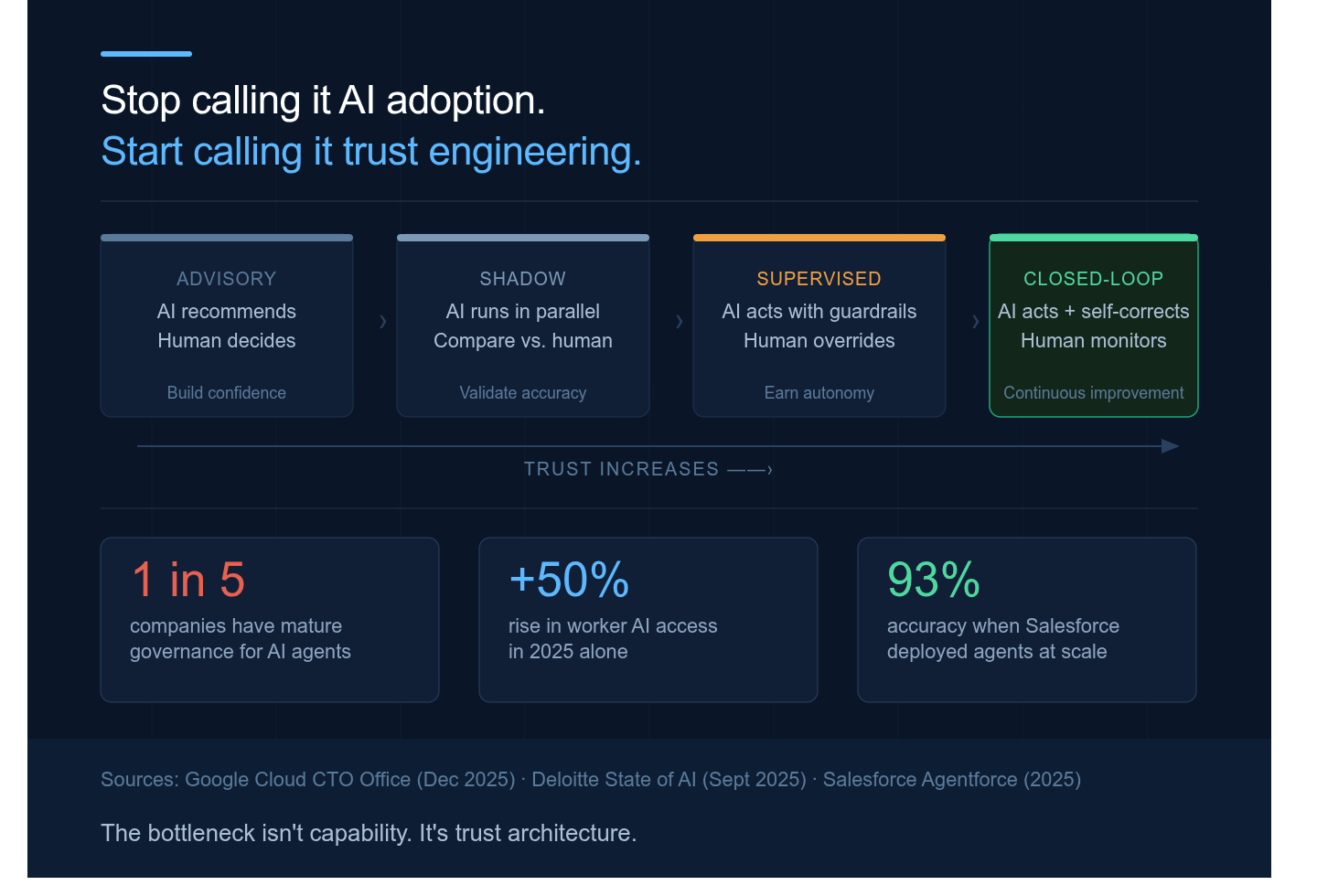
Here’s the thing nobody talks about: companies aren’t failing at AI implementation because the technology is too hard. They’re failing because they’re trying to bolt AI onto existing systems without building trust first.
When we call it “AI adoption,” we’re treating it like a software rollout. Download, install, done. But that’s not what’s happening in the real world. What’s actually happening is teams trying to figure out if they can trust a system that makes decisions they don’t fully understand. That’s a completely different problem.
Trust engineering is the real work. It’s about designing systems that humans actually want to use because they can verify the logic, understand the trade-offs, and catch errors before they spiral. It’s about documentation that matters. Audit trails that tell a story. Guardrails that protect both the business and the user. It’s about making AI explainable enough that your team can sleep at night.
This reframe changes everything. Instead of asking “How do we adopt this faster?” you start asking “What would make this trustworthy?” Instead of pushing rollout dates, you’re engineering confidence. You’re building feedback loops. You’re creating transparency where there was opacity.
The companies winning right now aren’t the ones moving fastest. They’re the ones moving smartest, building organizational muscle around trust. That’s the competitive advantage nobody sees coming.
Next time someone asks about your AI strategy, try this: tell them you’re doing trust engineering instead. Watch how the conversation changes.