If you wait for the “perfect AI use case” before testing AI in your industrial processes, you will never start.
And if you never start, you will never get your business, your teams and your industrial processes ready for the real AI breakthroughs that are on the horizon.
By running pilot projects and applying AI in both office and production environments, the organisation is actively adapting so AI can be integrated seamlessly wherever it adds value.
Don’t expect the first projects to change everything. Some will deliver small gains. Some may deliver nothing. And that’s fine. As long as you’re not losing efficiency or profit, you’re building knowledge and the infrastructure your business needs.
The real prize isn’t the quick wins today. The real value is how to prepare your business now for the next major advancements in AI.
- Your teams learn how to utilise AI into workflows.
- Your equipment investments are done with AI integration in mind.
- Your business decisions instinctively also weigh AI opportunities.
That’s the groundwork for what comes next.
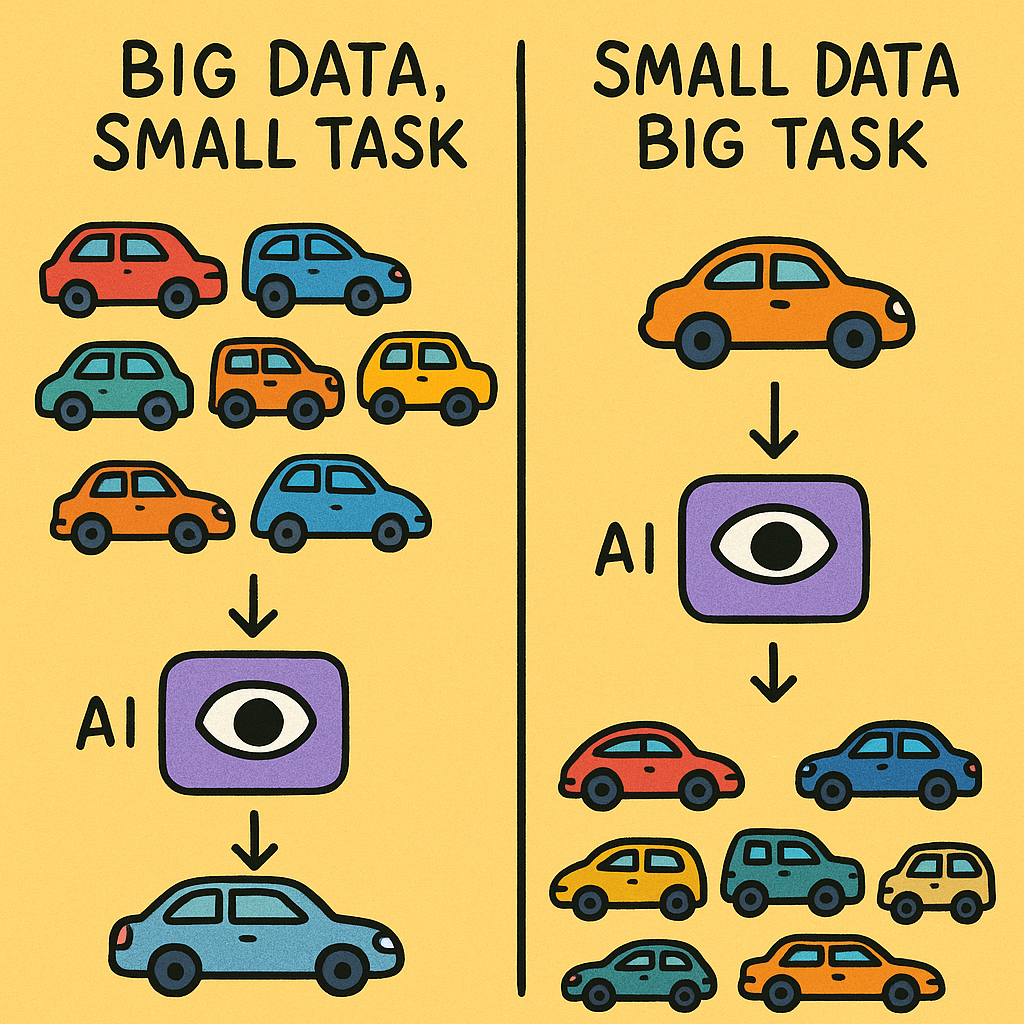
Right now, AI is “Big data, Small task”. Using advanced complex pattern recognition through huge troves of data analysis to solve problems. Useful, but limited in abilities.
The next revolution is “Small data, Big task”, a vision championed by Song-Chun Zhu.
This is AI that understands the concepts of what it sees not just patterns in existing data, like going to school.
It can adapt effectively to new challenges and solves problems without requiring oceans of training data.
That’s when industry will see true transformation !
This shift is coming in the next 5 to 10 years. Companies experimenting now, even with minimal to modest gains, will be the ones ready to capitalise quickly when it arrives.
And those who are ready to move fastest will capture the big gains every company is chasing.